Understanding and Preventing Fetal Alcohol Spectrum Disorders (FASD)
By NCADD-RA Director Jennifer Faringer, MS.Ed., CPP-G
While September is Fetal Alcohol Spectrum Disorders Awareness (FASD) month, it’s important to understand and prevent FASDs year-round! What can you do? Share the importance of staying alcohol-free while pregnant with friends and family. No amount of alcohol that has been proven to be safe to drink at any time during pregnancy. This includes beer, wine, wine coolers, or any form of alcoholic beverage which are all just as harmful to the unborn child as hard liquor.
Alcohol affects multiple organs in the body with the brain (specifically the brain’s executive function/decision making) being the most severely impacted. Alcohol use during pregnancy can affect a child’s cognitive abilities, emotional regulation, and behaviors.
Fetal Alcohol Spectrum Disorders are the leading cause of preventable developmental/cognitive delays.
According to the Centers for Disease Control (CDC), 1 in 20 Americans may have an FASD which is 2.5 times more than autism. Among those who have been affected by alcohol in utero, there are a whole host of co-occurring conditions that include:
- 4% attention deficit disorder
- 1% cardiovascular problems
- 9% gastrointestinal problems
- 2% anxiety disorders
- 23% nicotine dependence
- 8% major depressive disorder
- 4% intellectual and developmental disorders
- 4% suicidal ideations
- 3% long-term drug use
- 8% post-traumatic stress disorder
Health care professionals are encouraged to consider pre-natal alcohol exposure and FASD when working with patients that have any of the above co-occurring disorders. Proactively, healthcare professionals, along with families and friends, are all encouraged to discuss the importance of an alcohol-free pregnancy.
In New York State, over 221,500 babies are born annually with over 11,000 estimated to have FASD. These numbers far exceed the diagnostic capacity. Over 90 percent of individuals with FASD develop co-morbid mental health conditions. For older youth and adults with FASD, they struggle with independent living and finding and/or maintaining employment. Individuals with FASD who may or may not be diagnosed face high rates of incarceration and recidivism. The annual cost for FASD in New York State alone is over $12.03 billion and includes health care, special education, residential care, productivity losses, and corrections costs.
Of nearly 2.5 million students in NY schools, as many as 122,850 may have FASD with far fewer begin diagnosed. Without the appropriate diagnosis, students with FASD experience a higher-than-average school exclusion rate.
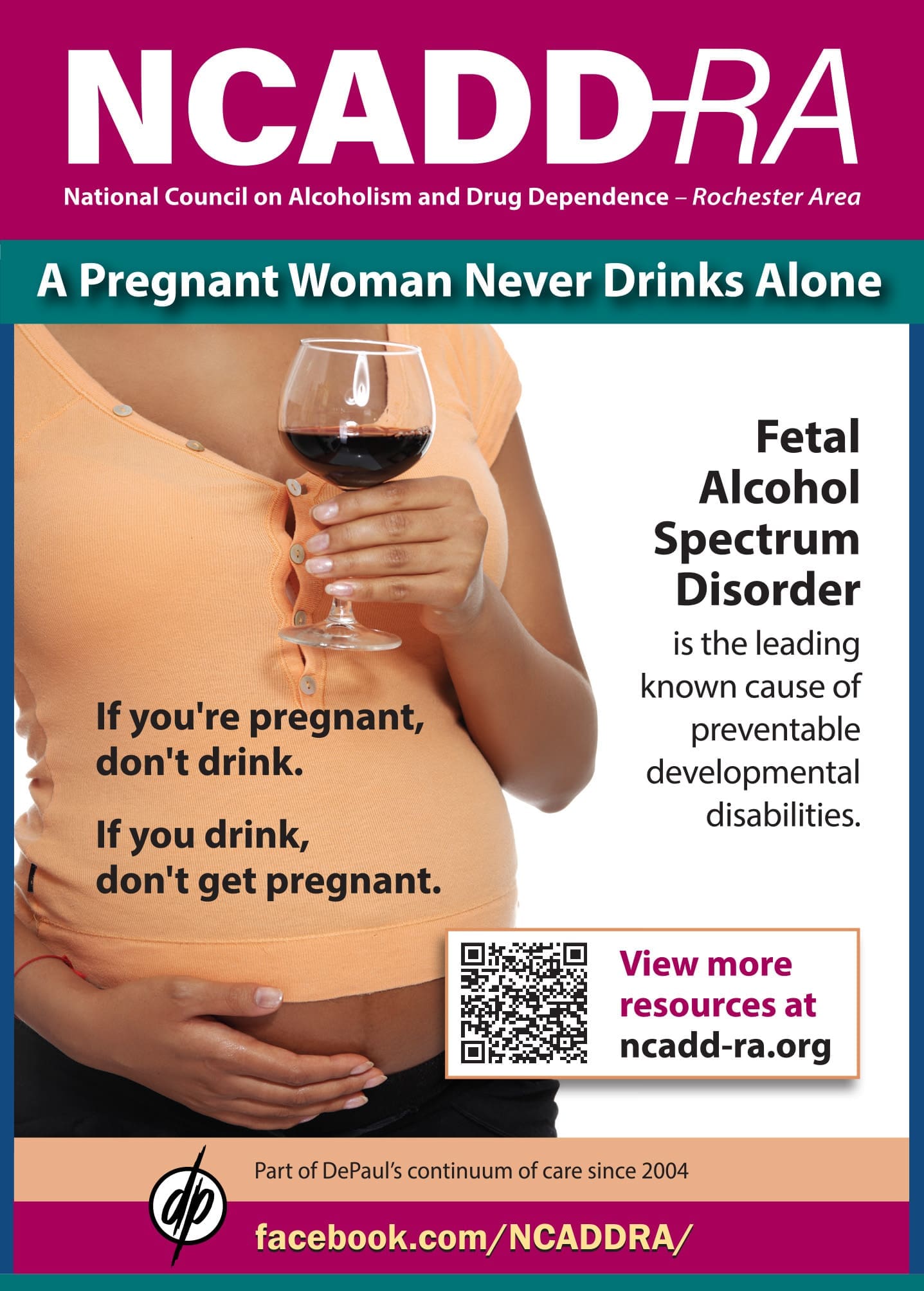
A Pregnant Woman Never Drinks Alone! There is no proven safe level of alcohol use during pregnancy.
Help is available! Locally, we are fortunate to have a FASD Diagnostic and Evaluation Clinic through the Developmental and Behavioral Pediatrics at URMC’s Golisano Children’s Hospital. Additional intervention resources are also available through URMC.
Information and education are available through the National Council on Alcoholism and Drug Dependence – Rochester Area (NCADD-RA). For parents of children with FASD, the NCADD-RA hosts a FASD Parent Network and Support group monthly. To learn more, visit our website at www.ncadd-ra.org. To schedule a presentation for your school or community group, contact [email protected].